
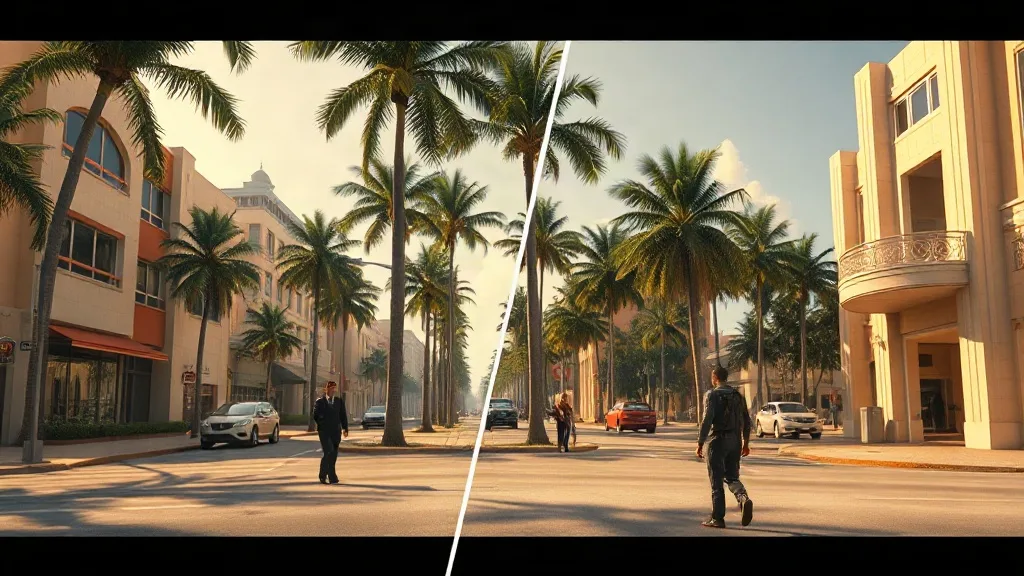
Picture this: a sun-drenched street lined with palm trees, art deco buildings in pastel shades, and a muscular figure strolling past a neon-lit storefront. The camera pans smoothly, capturing the lazy afternoon vibe of Miami's Ocean Drive. It looks like a scene lifted from a travel vlog. But it's not. It's a clip from Grand Theft Auto VI, and it's so realistic that thousands of people shared it thinking it was real life. The confusion is understandable. After all, GTA 6's first trailer, released in December 2023, showcased a level of graphical fidelity that blurred the line between video games and reality. But this latest clip, which surfaced on social media, took things to a new level.
The video in question is a short gameplay snippet, likely captured from the game's development build or leaked footage. It shows a character walking down a street that looks suspiciously like Miami's iconic Ocean Drive. The lighting, the reflections, the bustling crowd, and the detailed textures all contribute to an uncanny realism. Many viewers, including some who should know better, were quick to declare it real. It wasn't until eagle-eyed fans pointed out subtle clues—like the slightly unnatural character movement and the game's signature UI elements—that the truth emerged. This incident isn't just a funny mix-up; it's a sign of something bigger. As video game graphics approach photorealism, our ability to distinguish between the digital and the real is being tested like never before.
The Anatomy of a Viral Mix-Up
So how did a GTA 6 clip end up masquerading as real Miami footage? The answer lies in the game's setting. GTA 6 returns to Vice City, a fictionalized version of Miami, and Rockstar Games has gone to great lengths to recreate the city's atmosphere. From the art deco architecture to the Latin American influence, the game's world is a love letter to Miami. When the clip appeared online, it was easy to mistake it for a real-life street scene because it was designed to look exactly like one. But there were clues. The character's walk cycle, while improved, still had that slightly robotic quality that gamers recognize. The lighting, though impressive, had a hyper-real sheen that is characteristic of modern game engines. And the lack of real-world imperfections—like litter, potholes, or random graffiti—gave it away to those who knew what to look for. Yet, for the average viewer scrolling through their feed, the clip was convincing enough to warrant a double-take.
This isn't the first time a game has been mistaken for reality. In 2018, a Red Dead Redemption 2 screenshot was shared by a wildlife photographer who thought it was a real photo. More recently, Microsoft Flight Simulator has produced images so realistic that they've been used in news broadcasts. But GTA 6 is different. It's not a niche simulation; it's a mainstream cultural phenomenon. Its visuals are scrutinized by millions, and its release is one of the most anticipated in entertainment history. The fact that its gameplay can be confused with reality speaks volumes about the technological leap we're witnessing.
Why Realism Matters: The Tech Behind the Illusion
Rockstar Games has always pushed the boundaries of what's possible in open-world games. With GTA 6, they're leveraging the power of the PlayStation 5 and Xbox Series X to create a world that feels alive. The game's lighting system, for instance, uses ray tracing to simulate how light bounces off surfaces, creating reflections and shadows that mimic real life. The character models are more detailed than ever, with individual strands of hair and pores visible on close inspection. The crowd density and AI behaviors make the streets feel populated and dynamic. All these elements combine to produce a level of immersion that can fool the untrained eye.
But it's not just about graphics. The game's art direction plays a crucial role. Rockstar's team spent years researching Miami's culture, architecture, and vibe. They've replicated specific landmarks, like the Fontainebleau Hotel and the Colony Theatre, and infused the world with the city's unique blend of cultures. This attention to detail creates a sense of authenticity that resonates even with people who have never set foot in Miami. When you add in the dynamic weather system and day-night cycle, the result is a world that feels less like a game and more like a simulation.
The Uncanny Valley of Gameplay
Despite the realism, there's still something off about the clip. The character's movements, while fluid, lack the subtle micro-expressions and natural pauses of a real human. The way they interact with the environment—like opening a door or bumping into a pedestrian—still has a hint of artificiality. This is the uncanny valley: the point where a digital creation looks almost human but not quite, causing a sense of unease. Game developers are constantly trying to cross this valley, but it's a moving target. As graphics improve, our expectations rise, and the tiniest imperfections become glaring. In the GTA 6 clip, the uncanny valley is evident in the character's eyes and the way they glide rather than walk. These are the tells that give away the game's digital nature.
The Blurring Lines: When Games Become Reality
The GTA 6 mix-up is a symptom of a broader trend: the increasing difficulty of distinguishing between computer-generated imagery and real life. This has implications beyond viral videos. In the near future, we may see games used for virtual tourism, where people explore digital replicas of real cities. Already, companies are using game engines to create digital twins of real-world locations for urban planning and training. The line between entertainment and simulation is blurring, and GTA 6 is at the forefront of this shift.
Moreover, the incident raises questions about media literacy. In an age where deepfakes and AI-generated content are rampant, the ability to critically evaluate visual information is more important than ever. The GTA 6 clip fooled many because it played on our assumptions: we see a street scene and assume it's real. But as technology advances, we'll need to be more skeptical and look for the subtle signs that something is digitally generated. This doesn't mean we should stop enjoying viral content, but we should be aware of its origins.
What This Means for GTA 6's Launch
For Rockstar Games, the viral mix-up is a double-edged sword. On one hand, it's free publicity that showcases the game's graphical prowess. On the other hand, it sets expectations sky-high. If a short clip can generate this much buzz, imagine the hype when the game finally launches. But with great hype comes great scrutiny. Players will dissect every frame, looking for flaws. The pressure is on Rockstar to deliver a polished experience that lives up to the promise. Given the company's track record, they're likely up to the challenge. But the incident serves as a reminder that in the age of social media, even a small clip can have a massive impact.
Beyond the Hype: The Cultural Impact of GTA
GTA has always been more than just a game; it's a cultural touchstone. Its satirical take on American society, its controversial themes, and its immersive worlds have sparked conversations about violence, freedom, and technology. GTA 6 is poised to continue this tradition. Set in a fictionalized Miami, it will likely tackle issues like social media fame, inequality, and crime. The game's protagonists, a Bonnie-and-Clyde-style duo, suggest a narrative that explores relationships and loyalty. As with previous titles, players will have the freedom to wreak havoc or simply soak in the atmosphere. The realism of the world makes the escapism more potent, and that's why the clip resonated so deeply. It offered a glimpse into a world that feels both familiar and fantastical.
The viral moment also highlights the power of community. It was gamers who debunked the clip, sharing side-by-side comparisons and pointing out the tells. This collective intelligence is a hallmark of the gaming community, which has become adept at analyzing trailers and leaks. In a way, the mix-up brought people together, sparking debates and excitement for the game's release. It's a reminder that gaming is a social experience, and the anticipation leading up to a major launch is part of the fun.
Frequently Asked Questions
Is the viral Miami clip really from GTA 6?
Yes, the clip is from GTA 6. It was likely captured from a development build or leaked footage and shows the game's recreation of a Miami-inspired street. Fans identified it as gameplay by noticing character animations and UI elements that are typical of Rockstar games.
Why did so many people think the GTA 6 clip was real?
The clip was mistaken for real life because of its high graphical fidelity, realistic lighting, and accurate recreation of Miami's atmosphere. The smooth camera work and lack of obvious game elements like health bars also contributed to the illusion.
When is GTA 6 expected to be released?
Rockstar Games has announced that GTA 6 is scheduled for release in 2025 for PlayStation 5 and Xbox Series X/S. A PC version is likely to follow, though it hasn't been officially confirmed.
How does GTA 6 achieve such realistic graphics?
GTA 6 uses advanced rendering techniques like ray tracing, high-resolution textures, and sophisticated lighting models. The game also benefits from the increased processing power of next-gen consoles, allowing for more detailed environments and character models.
Could this mix-up affect the game's development?
Unlikely. Rockstar Games is known for its meticulous development process and has a history of delivering polished products. The viral clip is more of a testament to the game's visual quality than a hindrance. However, it does raise expectations, which the developer will aim to meet.